
I am writing this post from the position of the holder of a bachelors degree in psychology. These are insights I learned from my classes about the biology and chemistry of how we learn, I thought I would
Content
- The basic unit of the nervous system
- The basic mode of communication of the nervous system
- Memory
- How practice makes perfect, neurologically speaking
- If you want to know more
The basic unit of the nervous system
The basic cell that makes the nervous system is called a neuron.
This is their basic anatomy:

The body of the cell has dendrites that receive signals from other neurons. The nucleus receives the different signals and decides to fire or not a signal of its own. If it does, it sends it down the axon. Some axons can be very long and covered in myelin sheath which increases the speed of transmission. After travelling down the axon the signal reaches the terminal buttons which will then connect, via what we call a synapse, to the next nervous cell, or neuron. Here is the anatomy of a synapse:
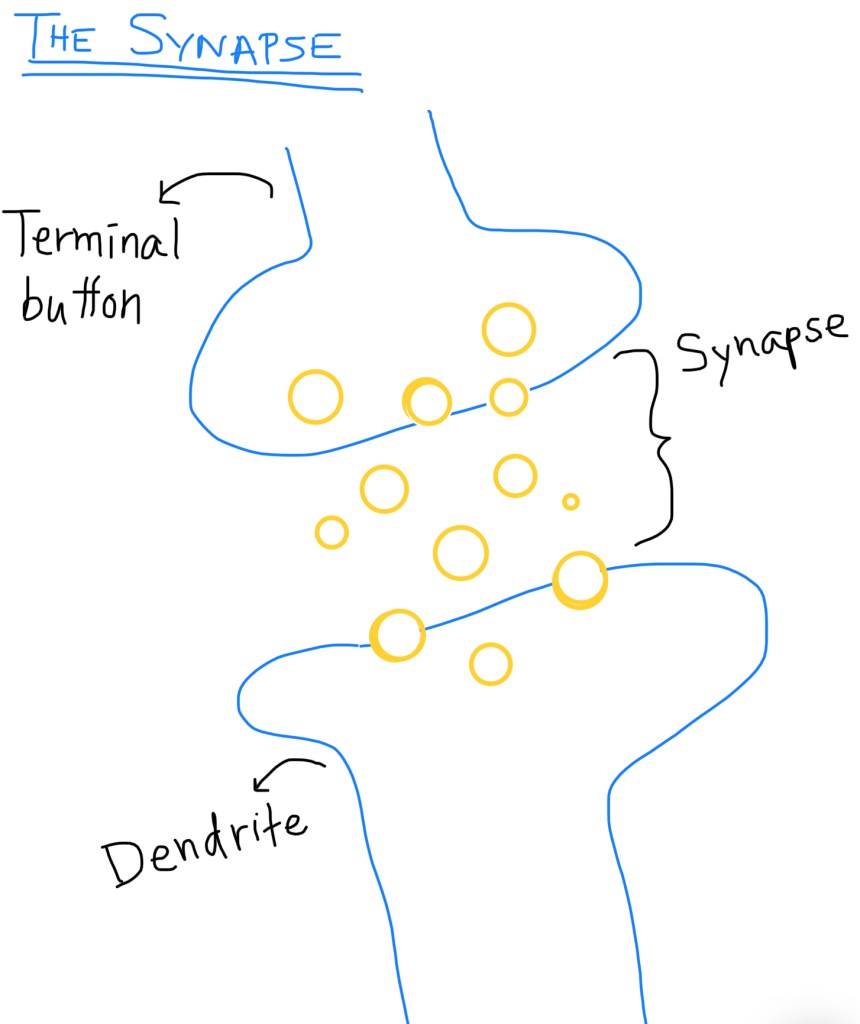
The synapse is the space between a terminal button and its destination (normally a dendrite, a muscle, or a gland cell).
The basic mode of communication of the nervous system
Neurons use action potentials to communicate information to each other and the rest of the body. When the action potential reaches a cell, that cell might be told to release chemicals: hormones and/or neurotransmitters. These in turn will affect our behaviour (getting stressed) or our metabolism (start puberty).
Memory
So how do our neurons “learn” a piece of knowledge? Let’s say you learn something new about apples. So first your network of data related to apples activates, crosschecks the new item and sees where to fit in. So new links, or synapses, will be made connecting to the new item. But this newly build link is weak, because it’s new and the brain doesn’t know if you just need the information on the short term or if you want to store it for the long term. The more often neurons fire together, the more the links (synapses) that connects them is reinforced and so you piece of data becomes learned.
How practice makes perfect, neurologically speaking
Given the previous explanation about memory, I’m sure you can deduce that the more you revisit a piece of knowledge, the more your neural links or neural pathways will be used, the more your brain will learn it has to maintain them, the more your knowledge will be solidly ingrained in you.
So when our teachers asked us to study everyday, do homework about the material seen in class, when they quizzed us, then pretested us, then tested us, they were trying to sustain in us the neural pathways of their teaching.
Now obviously reciting the lesson by heart or repeating the same exercise over and over again is dull, boring and disheartening. So I’m not suggesting these are your inevitable fate if you want to truly master knowledge, although sometimes it’s inevitable. ☞ Want to learn tips and tricks on rehearsing your knowledge?
Also as a side note, the brain plasticity is the ability of our neural networks to rewire and grow. It used to be believed that this ability was lost as we aged, but that is not the case. So even if you are considerably old, your brain is far more capable than we give it credit.
If you want more
☞ I made this post about educational sources that teach about psychology and artistic sources that explore and illustrate themes in psychology. I’m constantly adding to it. Well worth a glance 😉
➤ Recap
In this post you read about:
- What makes up our nervous system;
- How it works;
- How it stores and maintains knowledge;
- How you can use your biology to improve your memory;
- Sources to learn more about psychology 😁
Questions/Comments
☞ Did anything blow your mind?
☞ Is there a topic you would like to see explored with more depth?
☞ Let’s chat in the comment section.
 The ESL Teacher C · Nomad Educator
Leave a comment